
How to Align Philanthropy and Donations with Your Financial Goals



For the charities and causes you choose to support with donations and charitable gifts, how and when you give can make a big difference to the organization and for you. Using your investment accounts for charitable donations is one way to maximize charitable impact alongside your investment portfolio and strategy. And by not waiting until the end of the year, you give organizations a better chance to plan, cover costs, and build with confidence.
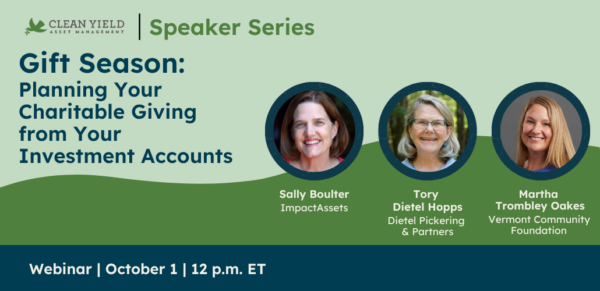
In October 2026, Clean Yield hosted a webinar, “Gift Season: Planning Your Charitable Giving from Your Investment Accounts.” The conversation, moderated by Clean Yield’s Dorigen Hofmann, covered how to align philanthropy and donations with your financial goals for the strongest positive impact.
The webinar, summarized below, covered some of the most popular charitable giving options in time to put a plan in place before the end of the year. You’ll learn strategies to make the biggest difference for the causes you care about, the ins and outs of tools like donor advised funds and qualified charitable distributions, and how to create a plan customized to where you most want to make an impact best suited to your financial plans.
Our panelists:
- Sally Boulter is the Senior Director of Engagement and Client Experience at ImpactAssets, where she leads organizational strategy to engage and empower clients towards maximum impact.
- Tory Dietel Hopps is a social, environmental, gender and financial activist. Tory is the Managing Partner at Dietel Pickering & Partners. In 2008, Tory began to move her own inherited wealth in alignment with her values.
- Martha Trombley Oakes is the Director of Philanthropy at the Vermont Community Foundation, where she oversees the Philanthropic Advising team. The team works closely with individuals and families to help them find and fund the causes that are meaningful and aligned with their values.
Watch the recording of the full conversation or read an edited excerpt from the webinar below. You’ll also find additional resources provided by the speakers at the end of the summary.
Dorigen Hofmann: We all have a choice of either being in reactive mode or being more planned or strategic with our giving. What does being more strategic look like?
Tory Dietel Hopps: Fall is the time of year when many people start getting approached by organizations for charitable donations. We have Giving Tuesday coming up, organizations are doing end-of-year appeals, and it is easy to get into a reactive mode. There is nothing wrong with that. For example, if your local food pantry reaches out because it is being inundated with requests, many of them due to cuts in SNAP benefits, and it moves your heart, you might make a donation.
But if you know that feeding your community is important to you, you could instead reach out to the food pantry and ask, “How can I structure my gift to help you this year? Do you need a matching or a challenge grant to help you inspire others? Is there one area of your work that’s hard to raise money for that I could help you with?” That is a more strategic, thoughtful, or planned approach.
One of the things we encourage clients to do is take some time—literally 30 minutes by yourself or with your partner—to list the issues you care most deeply about and want to support. It may be one issue or five or more, but if you want to have a deep impact, honestly, the fewer issues you choose to engage in, the deeper your impact will be.

Your Money, Your Values
This financial health guide gathers practical tips, trusted resources, and expert insights to help you safeguard your finances, care for your family, and contribute to the causes that matter most to you. You’ll find actionable guidance on fraud prevention, estate planning, charitable giving, and working with a values-aligned investment team.
Dorigen: For philanthropic support to have an impact and address the issues and organizations that donors care about, what are a few things to remember on the donation side?
Tory: General operating support or unrestricted support is the money that organizations need the most. It allows them to plan and gives them flexibility in how they spend their budget. They are the ones closest to the populations and the issues that you care about, so giving them the freedom to make decisions is one of the best ways you can support them. It also signals that you are buying into their mission. If you can do a multi-year gift, those are the most helpful to organizations because they can plan further out. It saves them time—they don’t have to keep coming back annually to ask you for support—and it saves you the hassle of being asked on a regular basis.
General operating support or unrestricted support is the money that organizations need the most. It allows them to plan and gives them flexibility in how they spend their budget. They are the ones closest to the populations and the issues that you care about, so giving them the freedom to make decisions is one of the best ways you can support them. It also signals that you are buying into their mission.
Dorigen: What are some of the ways people can think about impact investing alongside their charitable giving?
Tory: A tool that many donors don’t know about, or forget about, is the opportunity to make impact investments in the areas that they care about. This can be done through your personal investments, retirement accounts, cash holdings, or through a charitable vehicle. For example, I personally give to our state’s homeless shelter, but that is a short-term solution. I also invest in a community fund that provides loans to low-income senior and veterans’ housing because that is a permanent solution. I can hold that investment in my donor advised fund, and I also hold it in my retirement account. I am giving donations to an organization that is doing immediate service, and I am investing in a longer-term solution.
Dorigen: If you have money sitting in a foundation or donor advised fund (DAF), how should you think about the money that is not going out the door as charitable grants?
Tory: When you put money into a foundation or donor advised fund, you have received the charitable tax deduction. That money has come off the public tax rolls. If that money has gotten the tax deduction and it’s off the tax rolls for the public, I believe you should be utilizing that money to do as much good in the world as you can. I encourage you to look for impact investments that align with the kinds of charitable giving you do.
Dorigen: What are the benefits of a DAF and how can you use one to “punch above your weight”?
Sally Boulter: The best way I’ve heard a DAF described is as a philanthropic checkbook. You make a contribution to a DAF sponsor like ImpactAssets or a community foundation, you get a tax deduction in that giving year, and you can make grants out over time.
A lot of people choose DAFs for tax planning purposes. You can make a bigger contribution in one year and grant it over two years, which can be beneficial under current tax laws. Other people want to be part of a community of donors they can work with to do grants together, or they want to support their own community, or they want to create a legacy. There are a number of different kinds of DAFs out there, and each has a strength that you can play to. The key is thinking about what you want to accomplish and finding the vehicle that supports that.
We have a number of DAF holders who also have a family foundation and find having a DAF very useful. There may be times when they want to give anonymously, and doing that through the DAF is a great way to do it. Multiple family members can also contribute to a DAF.
Dorigen: What are some of the “cool” things you can do through a donor advised fund that people might not realize are possible?
Sally: At ImpactAssets, we have normal managed portfolios, but we also curate, diligence, and put on our platform impact-specific private debt and equity funds. If you care about clean energy or financial inclusion, you can participate in those funds through recommending them for your DAF. Those funds usually have huge minimums—$1 million or $5 million. We aggregate all of our donors, so you can do it with a smaller dollar amount. We have some you can invest in for as little as $25,000.
Another thing you can do through ImpactAssets and other DAFs is make bespoke investments. If you care about affordable housing or homelessness in your community, you could make your grant toward a homeless shelter, but you could also invest in a specific affordable housing project within your community.
Dorigen: What is a community foundation, and what makes it different from simply having a charitable account?
Martha Trombly Oakes: At its heart, a community foundation is a bridge between people who want to give and the communities they care about. We bring together charitable resources, knowledge about community needs, and deep relationships with nonprofits and community leaders. That allows us to help donors give in ways that are thoughtful and effective, while also helping strengthen the community over the long term. What is particularly special about the Vermont Community Foundation is that we are deeply rooted here in Vermont. We can help someone understand a particular issue, discover an organization they might not otherwise know about, connect their giving to a larger opportunity, or think about how philanthropy fits into their family or broader financial life.
Dorigen: Where should donors start?
Martha: The starting point really is what matters to you. What do you want your philanthropy to accomplish, and what kind of impact do you want to have? Those are the starting questions that we’re going to ask you when we sit down with you. Then we can talk about whether a donor advised fund, a designated fund, a qualified charitable distribution (QCD) gift, a gift of appreciated assets, a planned gift, a mission investment, or another strategy would make sense for you.
The starting point really is what matters to you. What do you want your philanthropy to accomplish, and what kind of impact do you want to have?
Start with your values, not a vehicle.
Dorigen Can you explain qualified charitable distributions, or QCDs, and why they can be useful?
Martha: A QCD allows someone who is 70½ or older to make a direct transfer from an IRA, a retirement account, to an eligible 501(c)(3) charity. The distribution can count toward the donor’s required minimum distributions (RMDs) once RMDs apply, and the amount is generally excluded from taxable income, subject to the applicable rules and limits. QCDs may be a very useful strategy because the money can go directly from the IRA to the eligible charitable organization. A QCD cannot go into a DAF. We encourage people with QCDs to consider investing in people, place, or purpose funds.

Stay up to date with the impact investing landscape with our newsletter.
Clean Yield uses the power of investment and markets to help our clients achieve their financial goals and move society toward a more just and sustainable future. Discover more about our work, the change we seek, and our efforts to make a positive impact.
Dorigen: Clean Yield received a question about whether there is a list of organizations that might align with someone’s giving values. Where should people start?
Martha: The Vermont Community Foundation publishes a brochure each year called our Giving Guide. It is my favorite piece that we do because it is so practical. It walks people through a process of finding out what they ultimately care about, and it includes information about Vermont nonprofits doing work in various areas. I would also recommend looking at our website because we profile a number of nonprofits in the state. Our annual reports are packed with great information about nonprofits that we’ve partnered with, so those can be a good starting point as well.
Tory: There is a wonderful resource called ReWeaving Wealth. We use it with clients all the time. It is a series of card decks that will take you through a process to get greater alignment. And once you get clearer about the issue areas you care deeply about, there are many entities in the United States that are collectives of different funders. If you have a particular area of interest, those can be a great place to go deep with colleagues and people who care about an issue and learn about some of the more innovative entities working in that area.
Dorigen: Is there a best time of year to give, or is it really just about giving when you can?
Tory: First of all, if the only time of year that you can give or are inclined to give is the end of the year, don’t stop giving. But if you’re making a sizable gift for you, finding out from the organization when their calendar year is and giving as early in their calendar year as you can is the most helpful to them. Most nonprofits in the United States have three months of operating capacity, which means they are under a lot of cash-flow stress. The sooner in the year they can get a gift from you, the more it allows them to not stress about their budget for the rest of the year.
Dorigen: What is the biggest thing you hope donors take away from this conversation?
Tory: Sometimes this financial work can feel really overwhelming. I was overwhelmed when I started this work 14 years ago. But I hope you’ll remember a quote from Ruth Bader Ginsburg: “Real change, enduring change, happens one step at a time.” I hope you’re inspired today to take at least one step.
Martha: Ultimately, the question is what matters to you, what you want to do with your wealth, and what you want to accomplish. You don’t have to figure all of this out alone. The best philanthropic planning often happens when the donor’s goals are at the center and the philanthropic advisor, financial advisor, attorney, and tax professional are all working together. Our role is to translate your values into meaningful community impact. We don’t decide what someone should care about or what their philanthropy should look like. The donor leads. We help them understand the possibilities and navigate the path.
Sally: There is a whole big, beautiful world out there of being able to make a difference. The key is to partner with people who understand what can be done. There is just a lot that one can do that you don’t think about, so I would encourage people to think outside of their own box and think about adding a few investments.
Additional resources from our panelists:
More News & Insights
Q3 2026 Market Outlook: Weathering the Interest Rate Storm
Our team’s reflections on Q3 2026 and what to expect in the coming months from the market, inflation, bonds, investing, and more.

Stock Profile: Costco
Explore how Costco’s no-frills business model invests where it counts, from employee well-being and customer value to environmental and community impact.
Speaker Series— Gift Season: Planning Your Charitable Giving from Your Investment Accounts
Join our upcoming webinar about how to align philanthropy and donations with your financial goals for the strongest positive impact.
