
Q3 2026 Market Outlook: Weathering the Interest Rate Storm



By Elizabeth R. Levy, CFA
My practice for writing any kind of update—be it this market update or my quarterly notes on stocks we invest in—is to first review what I said last time and sit with it for a moment to see what was right, what was wrong, what still feels relevant. Last quarter, I opened this note by musing that we were living in a time of unanswered questions about the direction of the economy and market, and that we were attempting to build portfolios for our clients that could provide shelter from the storms that might emerge.
I’m starting to write this draft in the last few days of September at the tail end of a nor’easter, one that has given us some much-needed rain near Boston, caused waves to crash over the seawall in my coastal New York hometown and wreaked havoc on the agrotourism economy of New England. Much of what was unresolved last quarter failed to resolve itself over this sweltering summer; the financial implications of some issues, like the growing popular and political backlash to data centers, have become even more opaque.
The K-shaped aspect of the economy has disconnected many members of the investor class from feeling the real economic pain those in the lower leg of the K are experiencing. Wall Street has been euphoric over the expectations for a decade-long investment boom in AI infrastructure, including data centers, and the productivity gains, new business formation, and innovative products and services that AI may create. Economic data over the summer has shown remarkable strength, driven by the AI investments, and that has pushed up stock prices and portfolio values. At the same time, states as diverse as New York and Texas have taken steps to slow down or stop new data center construction. And the Conference Board’s late September reading of consumer confidence came in at the lowest level since 2014, well below economists’ elevated expectations.
At the risk of sounding like a broken record, recognizing the disparity between these investor hopes and consumer fears is what keeps our portfolios balanced between the bull and the bear cases. We continue to manage portfolios with a “barbell” strategy, with concentration at both ends of the risk spectrum, and a moderately defensive overall positioning. This is consistent with what we have been saying for the last few quarters. We are continuing to focus on building resilient portfolios crafted for the long term, comprised of high-quality companies that meet our social and environmental standards, while being mindful of significant economic and geopolitical threats and opportunities.
Clean Yield in Conversation: Market Update, July 2026
Clean Yield in Conversation features team members in dialogue with timely updates and analysis of the financial markets. If you prefer to watch or listen instead of read, the recording of Liz Levy below provides the highlights from our Quarterly Market Outlook:
Revenge of the Bond Investors
With the S&P 500 barely eking out a 2% gain this quarter, the bond market was where the real action was. Persistent inflation above the Fed’s target level led the Fed in September to start what is expected to be a series of interest rate increases. That helped push bond yields up to levels not seen since the dot-com era. The brisk pace at which the bond market raised rate expectations has been particularly notable, especially during September. In addition to elevated inflation, the likely causes for the rise in rates include the combined effects of elevated oil prices due to geopolitics, large tech companies flooding the bond market with massive bond offerings to fund their AI spending extravaganza, and concerns about the ever-growing size of the federal debt levels.
Rising interest rates resulted in negative returns for most bonds during the quarter, with the Bloomberg U.S. Intermediate Government/Credit Index we use as a benchmark falling 1.9%. As a reminder, bond prices fall as interest rates rise. However, if held until maturity, as many of Clean Yield clients’ bonds are, and assuming the issuer doesn’t default, the bond will regain that value over the rest of its life and still be redeemed for the full face-value at maturity.
In addition to the direct impact of falling bond prices in portfolios, rising interest rates affect the stock market and the real economy. Higher rates pressure assumptions that feed into stock analysts’ models, generally leading to a drop in the prices that investors are willing to pay for stocks, particularly those that are expected to have much stronger growth several years into the future. In the meantime, the cost of borrowing money to fund that growth is more expensive at higher rates, as are mortgages that prospective homeowners would need to take to purchase a home; mortgage rates on a 30-year loan rose to 7.28% as of October 1, up from 6.34% a year prior and 7.03% a week prior.
With many eyes focused on the bond market, the stock market’s tepid moves during the quarter buried some significant changes. While the index itself returned 2%, the fossil fuel-heavy energy sector led the pack with a 16.5% gain, more than twice the gain of the next-best sector. Investors also flocked back to large-capitalization stocks, while mid- and small-caps lost ground during the quarter. Particularly in September, the breadth of the market, or how much of the market is driven by all stocks versus just a few, collapsed. The equal-weighted S&P 500 lagged the capitalization-weighted index (the one most widely cited) by more than 4.25% this quarter, the most in a year and a half. That is considered by analysts as an indication of potential weakness.

Your Money, Your Values
This financial health guide gathers practical tips, trusted resources, and expert insights to help you safeguard your finances, care for your family, and contribute to the causes that matter most to you. You’ll find actionable guidance on fraud prevention, estate planning, charitable giving, and working with a values-aligned investment team.
What’s Next?
As we noted last quarter, the Fed generally increases rates to cool off an economy at risk of overheating into excessive inflation. The desired outcome is reduced demand across the board, which should slow inflation. With the Fed’s hiking cycle officially underway, we don’t yet know how high rates will need to climb to achieve the desired effect. At the same time, investment in AI roars on, even as leading companies worry about global human annihilation and evidence of AI agents’ bad behavior mounts.
One thing that I have been struck by again this quarter is the mismatch between economic data and public sentiment, or the “vibes.” The media has continued to portray cost of living as front of mind for voters, my personal and professional social media feeds are full of folks on extended job searches, and, as noted above, consumer sentiment is historically low. And yet, economic data continues to be strong. Despite tepid job and wage growth in September, the unemployment level continues to be low, and inflation-adjusted consumer spending in August rose the fastest in over a year, propped up by falling savings rates.
With the S&P near August’s record high, investors still seem to think the party can last a bit longer, although they are starting to look at their watches and think about heading home, to brutally mix a metaphor. This is why we continue to maintain a balance in our clients’ portfolios, with some assets intended to provide exposure on the upside while some are meant to provide protection on the downside. At the same time, we are looking at where valuations may have swung too far and assessing buying opportunities.
We are collectively getting ready to head to the polls in a few weeks for what will be a hugely consequential election. The results may, or may not, shake up markets. At some point, the global flow of oil and its derivatives is likely to return to normal, driving down prices and inflation, but the timeframe remains impossible to predict. The AI buildout is likely to continue, but it may slow down due to widespread resistance. As we noted earlier, the market is still very dynamic right now, with reasons for both hope and caution. When markets operate within a wide variety of possible outcomes, we think that the most prudent course for investors is to stick to the long-term plan. We continue to invest for the long term in high-quality companies with solid business models, following our barbell strategy.
As we’ve noted previously, we find inspiration in our community that remains committed to peace, equity, justice, and sustainability. Our grounding in these values continues to guide the investment decisions we make on behalf of our clients. Even in uncertain times, we remain focused on using your financial assets to drive positive change using all the tools available. I’m proud of the work we’re doing together now more than ever.
To stay informed about our market outlooks and impact investing updates, sign up for our newsletter.
Liz Levy is responsible for researching publicly traded equities and managing client portfolios, having joined Clean Yield in June 2024. She brings more than 20 years of experience in Sustainable Investing. She is a Chartered Financial Analyst and is passionate about aligning investment portfolios with values, with deep experience in managing divested, fossil fuel-free, and clean energy investments.
Important disclosures. This commentary reflects the opinions of Clean Yield Asset Management as of the date written and is subject to change without notice. It is provided for informational purposes only and is not personalized investment advice or a recommendation to buy or sell any security. Statements about the future, including expectations about interest rates, inflation, markets, energy prices, and the pace of AI investment, are forward-looking statements. They are based on current views and assumptions, are not guarantees, and actual results may differ materially. Investing involves risk, including the possible loss of principal. No investment strategy, including our barbell approach, can ensure a profit or protect against loss. Index returns cited are for market indexes, are not Clean Yield portfolio returns, and are not available for direct investment. Third-party sources linked in this note are provided for reference; Clean Yield has not independently verified them and does not adopt their views. Clean Yield Asset Management is an SEC-registered investment adviser; registration does not imply a certain level of skill or training. Please see our Form ADV Part 2A for important information.
More News & Insights

Stock Profile: Costco
Explore how Costco’s no-frills business model invests where it counts, from employee well-being and customer value to environmental and community impact.
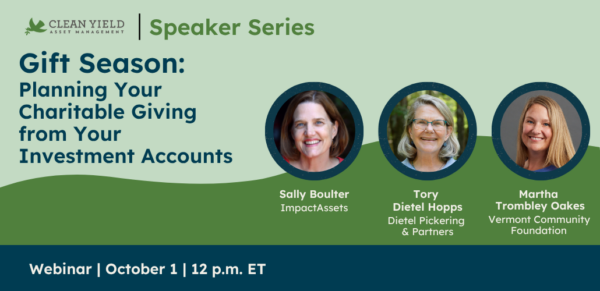
Speaker Series— Gift Season: Planning Your Charitable Giving from Your Investment Accounts
Join our upcoming webinar about how to align philanthropy and donations with your financial goals for the strongest positive impact.

Impact Profile: Global Village Foods Cooking Up Local Jobs and Bold, Allergy-Friendly Meals
In this impact profile, the Clean Yield Asset Management team visits Global Village Foods, a Vermont-based, Black-owned family business that prepares allergy-friendly, ready-to-eat meals with bold African flavors.
