
The Role of Private Capital in Building Affordable Housing for Resilient Communities


A Clean Yield Speaker Series Webinar Summary
Affordable housing remains one of the most urgent challenges facing communities across the U.S. We continue to see a widening gap between housing costs and income levels. At the same time, rising construction costs and higher interest rates have made it more difficult to finance new projects.
“While public funding plays a critical role, it is not sufficient on its own to close the housing gap,” said Monica Charletta, Clean Yield Associate, Impact Investing, in our webinar on affordable housing and private capital. “Affordable housing is not only a social imperative but also an area where thoughtfully deployed private capital can be catalytic in helping close critical financing gaps.”
To deepen the understanding of how Clean Yield investments are putting capital to work in communities, in March 2026, Clean Yield hosted a webinar on affordable housing, moderated by our team members Kofi Kodua, Managing Director and Portfolio Manager, and Monica Charletta.
Three affordable housing experts, from organizations that are included as options in Clean Yield’s impact investing portfolios, provided insights:
- Gabriel Treves-Kagan is the Vice President of Development at the Latino Community Credit Union (LCCU), a bilingual, federally insured credit union with Community Development Financial Institution (CDFI) and Minority Depository Institution (MDI) certifications and a low-income designation. LCCU provides ethical financial products and education to 125,000 members.
- Katie McQuaid is Senior Vice President of Philanthropy & Community Engagement at New Hampshire Community Loan Fund (NHCLF). Katie oversees efforts to connect and collaborate with the community through philanthropy and policy programs.
- Sarah Phillips is Director, Housing & Community Facilities Programs at Vermont Community Loan Fund (VCLF), a statewide mission-based alternative community lender. In her role, Sarah provides flexible capital solutions to help projects and organizations access the resources needed to succeed.
The webinar covered misunderstood aspects of today’s affordable housing crisis, innovative financial partnerships that have helped projects cross the finish line, and examples of scalable community-based solutions.
“The solutions are many, and we know a lot about what works. There’s a lot of innovation happening in this space,” said Sarah Phillips. “But it will take a long time to get out of this, because it took us many years to get here.”
Watch the recording of the full conversation or read an edited excerpt from the webinar below. You’ll also find additional resources provided by the speakers at the end of the excerpt.
Monica Charletta: Sarah, from your perspective, what would you say is the most misunderstood aspect of today’s housing crisis?
Sarah Phillips (VCLF): First, I want to make sure that when we say crisis, we’re not implying that this situation happened suddenly. Where we are today in the housing market, and the difficulty in providing housing that’s affordable to people with the lowest or even middle incomes, was years in the making. The solutions are many, and we know a lot about what works. There’s a lot of innovation happening in this space. But it will take a long time to get out of this, because it took us many years to get here.
Second, for many years, there was a lot of focus on demand-side solutions, meaning, how can we make housing affordable to individuals to purchase or rent by lowering the price of entry? Now there’s been a move toward supply-side solutions, meaning, how do we build more quickly? I think that’s necessary and important, but I want to name that and ensure the conversation around affordable housing continues to consider the people at the lowest end of the scale. We cannot simply move all the way to the other side of the pendulum.

Stay up to date with the impact investing landscape with our newsletter.
Clean Yield uses the power of investment and markets to help our clients achieve their financial goals and move society toward a more just and sustainable future. Discover more about our work, the change we seek, and our efforts to make a positive impact.
Monica: Katie, how has the capital environment shifted in the past few years, and what pressures are you feeling the most acutely?
Katie McQuaid (NHCLF): Rising interest rates have made it more difficult to raise capital our borrowers can afford, specifically residents looking to cooperatively purchase their manufactured home communities when they come up for sale. In most manufactured home communities, the residents own their homes, but they pay a monthly lot rent to the owner of the land. Now private equity groups are targeting these communities nationwide, raising the lot rents so they can make a profit. They know the homeowners have no choice. They have to pay the higher rent or walk away from the home.
One great example of our work in this area is Cotton Farm Village Cooperative in southern New Hampshire. Over three decades and two failed attempts by the residents to purchase their community, one man named Guy continued to remain hopeful and filed the cooperative’s paperwork with the state every single year. And last summer, they became New Hampshire’s 152nd resident-owned manufactured home community.
Now they’re in control of their lot rents, which are invested back into the community. This only happened because of our investors, donors, and mission-aligned lending partners that provided the $19 million in below-market capital they needed to keep the community affordable for the residents.
Monica: Gabe, where are you seeing the largest financing gaps today?
Gabriel Treves-Kagan (LCCU): In terms of financing gaps, I can speak from our perspective as a CDFI and a credit union. CDFIs and credit unions, like the Latino Community Credit Union, play a unique role in ensuring communities that are traditionally under-resourced and under-invested have access to capital so that they can purchase a home and begin the process of building generational wealth.
The work of a credit union like ours is time- and resource-intensive. We work to create pathways into the financial mainstream for individuals and communities that are often underbanked or unbanked. Then we work to make sure that, once they become a member of our credit union, they are in a position to move along the financial continuum all the way to home ownership. That can be a long-term investment.
About 40% of our credit union members were previously unbanked, and about 70% of our borrowers report living with low levels of wealth when they take out their first loan. We’re working with a community that is often considered high risk, or just not worth it, by the conventional finance system. At LCCU, we know communities can make the most of the products and services we offer if we take the time to empower them, but that requires resources.
That’s where private capital can come in. We have been able to do our work because we have received support from depositors, like those Clean Yield works with, who are interested in making a mission-aligned impact deposit at LCCU. This enables us to fund our work and make sure communities that are traditionally underinvested in have access to high-quality loans.
Monica: I’d like to continue our discussion around how each of your organizations uses private capital, because you’re each taking a different approach to housing initiatives. Gabe, the Latino Community Credit Union describes itself as a patient lender, and I’m wondering how flexible or patient capital makes a difference in your work.
Gabe (LCCU): Since we started making mortgages in 2004, over 11,000 of our members have become homeowners. During this time, we have only had five foreclosures. In the last 10 years, we have not had one. The reason behind this success is the way we establish and maintain relationships with our members; we can act as a patient lender and are supported by patient capital and mission-aligned investors.
Our loan approval rate is higher than that of our peers. We say yes to more people than our peers. Yet our charge-off rate is lower than our peers, and our charge-off for mortgages is actually zero. How can it be that we say yes more often to a community that other financial institutions consider high risk, yet our members are succeeding, they’re thriving, they’re paying their mortgages, they’re building wealth?
It’s because we are a patient lender. We take time to invest in our members well before they take out their first loan.
We invite them to participate in our financial education classes. We walk them through our products and services. We set a personalized plan with them to help them build credit and savings. So when the time comes for them to purchase a home, they’re ready to succeed. Similarly, once they purchase the home, we keep all of our mortgages in-house. This allows us to continue to maintain a strong, long-term relationship with our borrowers. If a borrower comes upon hard times, we can set up a personalized payment plan so they have the support they need to pay their loans. I’ve seen over and over again that our members come to the credit union with dreams, talent, and determination. They’re ready to succeed. And when they are set up with the right high-quality loans and the support our branch staff provides, they do succeed. That is only something a credit union and CDFI like ours, that’s a patient lender, that invests in our members, that invests in relationships, can accomplish.
Monica: Sarah, how do you think private investment complements public housing funds in practice? And how does the Vermont Community Loan Fund blend different sources and types of capital?
Sarah (VCLF): As a CDFI, we provide financing for projects that are unable to get full financing from a bank or credit union. Sometimes a project has some financing from a bank or credit union, and we play a role in the overall capital stack as the gap lender. But whether we’re the senior lender, or a pre-development or construction loan, or a little tiny piece of subordinate debt, it’s our financing that becomes a key to unlock the deal. So we also think of ourselves as a patient lender.
Our secret sauce is our impact investment dollars, because that is what enables us to be more flexible than traditional lenders and not to have the same restrictions as public dollars.
We can flex in a way other funders can’t. We do our due diligence, but our funds are unrestricted compared to public funds or traditional finance. We also often partner with philanthropy.
I’ll highlight an example. We received a grant from one of our financial institutions targeted toward housing in a specific region of the state. Before they could close on construction and move forward, our partners needed a pre-development loan to do some of the due diligence work. We were able to use philanthropic dollars to offer a low-cost pre-development loan, which is important because the pre-development loan and interest are costs that go into the final project and ultimately raise the rent for the people in that community. The lower the cost of capital, the lower the rents can be. It was exciting to use those philanthropic dollars in a way that had an immense impact on the project.
Monica: Katie, I’d like to bring it back to you. What types of innovative structures or partnerships have you used to get projects across the finish line?
Katie (NHCLF): Like most CDFIs across the country, we provide very flexible terms to make deals pencil out. Many of the manufactured home communities we finance are interest-only for a period of time, and they have 10-year terms with 40-year amortization, so we can keep that monthly mortgage payment low.
This provides some breathing room as we spend the first decade of the loan helping residents navigate ownership and develop the governance structure of their community. After that initial 10 years, they can either refinance with us or with a traditional bank.
Not one of these resident-owned communities in New Hampshire has ever failed, and that’s because of the coaching and the guidance we provide.
But what about the homes themselves? Twenty years after we started helping manufactured home community residents become owners of their land, we learned that the individual homebuyers were turning to predatory lenders, personal loans, and even credit cards to purchase their homes.
We started offering fair, fixed-rate 30-year mortgages for manufactured homes. We call them Welcome Home Loans. In more recent years, we reduced another barrier to homeownership with our Homeowner Assistance Loans. We realized that homebuyers could afford the monthly mortgage, taxes, and insurance of a home, but they didn’t have that large chunk of change for the down payment and closing costs. Our Homeowner’s Assistance Loans are second silent 0% mortgages, up to $25,000, that are repaid only if the home is sold, refinanced, or the first mortgage is paid off.
Kofi Kodua: Thank you. I’d like to hear a quick forward-looking thought from each of you. Take this in whichever direction feels most relevant to you, whether it’s a structural barrier you would like to see addressed, or where you see the biggest opportunity for private capital over the next several years, or simply what gives you optimism in this work. Let’s start with you, Gabe.
Gabriel (LCCU): What gives me hope is always our members. In my 10 years here, I’ve seen that our members are determined. They need opportunity. The past few years have been a difficult time for many in our communities, but I love to see that, despite this, our credit union continues to grow. Over the last 12 months, our membership grew by 13,000, so more than 1,000 members are joining our credit union every month. What that tells me is that in difficult moments, our credit union is seen as a source of stability and opportunity.
We are proud of the work we do to usher folks into the credit union and empower them so that they can make the most of the opportunities we offer. What also gives me hope is an increased commitment from our mission-driven depositors to support our work. That support helps ensure that in this difficult time, all families, no matter their background, have access to quality loans and the support the Latino Community Credit Union offers. When our members have opportunity, they contribute deeply to our communities.
Katie (NHCLF): If I could change one structural barrier in affordable housing finance, it would be to have the same access to capital that private equity groups have. Private equity firms are buying up manufactured home communities across the country, and they’re able to get below-market capital from Fannie Mae and Freddie Mac. I would like to make that capital available to residents as well, when they want to purchase their communities. We have a team working to educate policymakers in hopes that we can change the current structure, but until then, we’re going to have to keep relying on our incredible mission-driven investors to help the residents compete for ownership of their communities.
Sarah (VCLF): Access to capital is still the fundamental piece that will drive affordable housing development. At VCLF, we think about who owns and builds housing, and we think about building homes as a way to transform communities. When that is your ultimate goal, you think differently about how to do lending and what lending needs are. In Vermont, we have a lot of different needs for housing, but we have a wonderful ecosystem of organizations working together to meet those housing needs. It’s really great to be a part of that network.
Additional Resources from our panelists:
Latino Community Credit Union
New Hampshire Community Loan Fund
Vermont Community Loan Fund
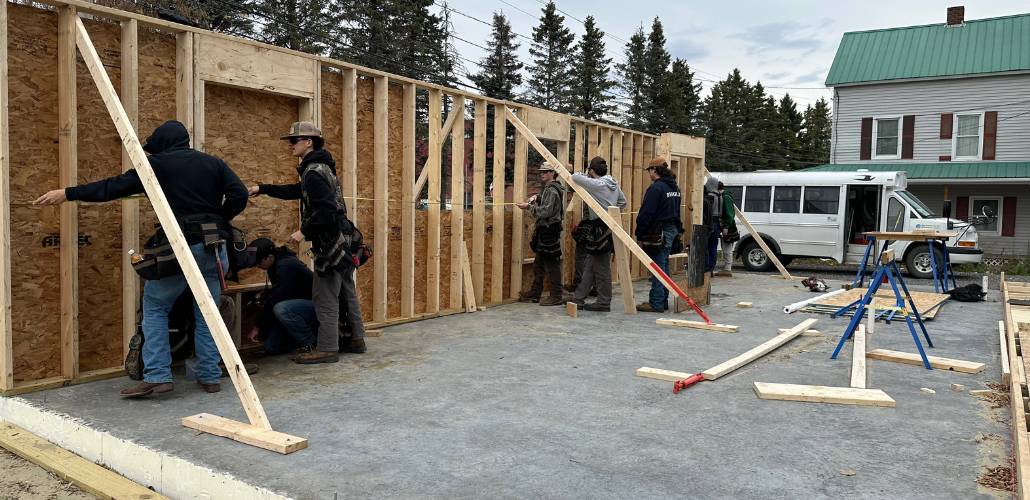
Photo courtesy of VCLF
More News & Insights

Q3 2026 Market Outlook: Weathering the Interest Rate Storm
Our team’s reflections on Q3 2026 and what to expect in the coming months from the market, inflation, bonds, investing, and more.

Stock Profile: Costco
Explore how Costco’s no-frills business model invests where it counts, from employee well-being and customer value to environmental and community impact.
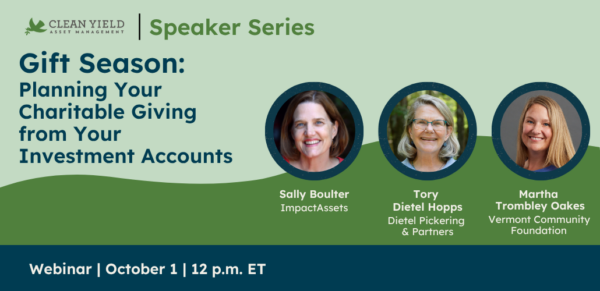
Speaker Series— Gift Season: Planning Your Charitable Giving from Your Investment Accounts
Join our upcoming webinar about how to align philanthropy and donations with your financial goals for the strongest positive impact.
