
Get to Know Clean Yield Impact Investing Associate Monica Charletta


Bringing Just, Regenerative Food Systems Background to the Team
With her background in impact-first regenerative food systems investing and ESG strategy consulting, Monica Charletta has joined the team as an Impact Investing Associate. Monica is responsible for sourcing, screening, and conducting due diligence on private impact investment opportunities at Clean Yield. At a time when using our investments to drive meaningful, systems-level impact is critical, we are thrilled to welcome Monica to our team.
Before joining Clean Yield, Monica supported impact-first investing in regenerative food systems at nonprofit organizations, including Proofing Station, Potlikker Capital, World Wildlife Fund, and Black Farmer Fund. Monica holds a joint Master of Environmental Management and Master of Business Administration from Yale University and a Bachelor of Arts in Environmental Science and Ecology from Rice University.
We asked Monica to share what led her to Clean Yield, what excites her about joining our team, and what she is planning for the future of impact investing.
How does your past experience align with the impact investing goals at Clean Yield?
I began my career in consulting at Deloitte, where my work primarily focused on the food and agriculture sector. I worked with large corporations to help them build more sustainable and resilient supply chains for the food inputs in their products. That meant engaging directly with farmers and ranchers in the United States.
Participating in discussions around mutually beneficial sourcing strategies and sustainability investments, in which my clients wanted to help farmers and ranchers increase their supply and build security, illuminated for me many of the systemic problems in our food system. For example, my clients were often uninterested in paying more for sustainable solutions, which led me to realize that consulting wasn’t the best route for me to drive systems-level change. I wanted to be closer to the flow of capital and think about how resources can be redirected toward a more regenerative and equitable food system.
I decided to attend graduate school and pursue not just an MBA, but also a Master of Environmental Management through a joint three-year degree program at Yale. I knew I didn’t want only investing acumen; I also wanted deeper subject-matter expertise in sustainable food systems.
I knew I wanted to do impact investing, so I sought out opportunities that were directly applicable. I co-founded our student-run impact venture capital fund at the School of Management, and later, after we officially launched it, I ran its operations with a few other dedicated students. I’m really proud of what we built, and those investments still exist today and are thriving.
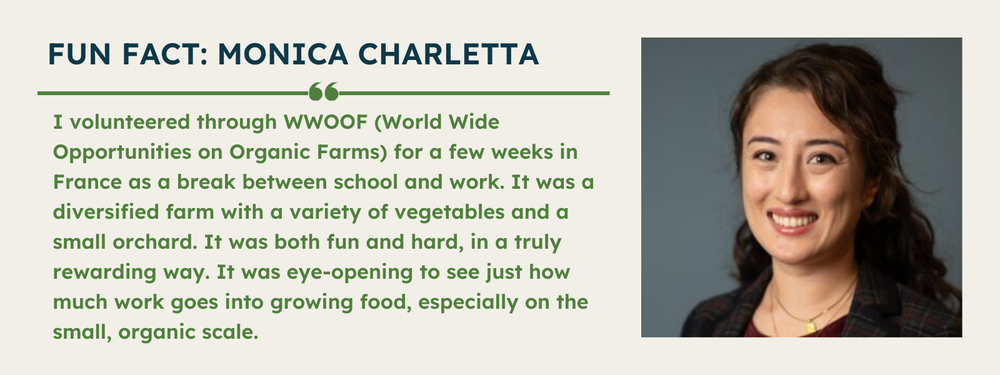
I also pursued internships, consulting projects, and independent studies directly in the field. I interned with the World Wildlife Fund’s Impact Investing Group, which primarily works in food systems. I also worked with the Black Farmer Fund on their due diligence processes. After graduation, I worked part-time with two nonprofits, Proofing Station and Potlikker Capital, both of which deploy capital into food systems. All of this strengthened my investing skills and deepened my understanding of the food system.
Working in a space I care deeply about is meaningful, and learning about the incredible work happening in areas such as affordable housing, solar energy, and racial justice has been energizing.
Coming to Clean Yield felt like the right step. While the impact investing at Clean Yield isn’t solely focused on food and agriculture, that’s where the firm has historically been rooted and where many of our clients are most passionate.
What are you excited about, and what challenges are you expecting, in the impact investing space?
Thinking about impact investing more broadly, there’s a growing awareness of the field. More people want to move their personal dollars toward impact, and more foundations are dedicating money toward program-related investments. There’s an increasing diversity of investment products, allowing for more tailored capital structures that match the needs of organizations.
We do have clients who are fully committed to impact investing, and Clean Yield is very forward about its values. That alignment is part of what drew me here.
In terms of challenges, the biggest ones right now are at the macroeconomic level: risk tolerance and how much capital people have on hand to invest. Increasing accessibility to these investments will be important. Across the industry, raising capital has become more difficult. Even funds that have raised significant amounts of money aren’t deploying it. If we’re all committed to impact, something has to give. I’m hopeful that more creative, flexible solutions can help bridge that gap.
How does Clean Yield’s mission fit into the broader landscape of impact investing and financial management?
One of the things that first attracted me to Clean Yield was its language around using capital for good. I’m a very values-driven person. Where you work and how you spend your money are two of the most significant areas where you can have a real impact in the world. Working with people who share these values is incredibly energizing.
Even though I have only just started at Clean Yield, I’ve already had conversations with teammates about the investments on which we’re conducting due diligence: “Is the impact real? Is this an opportunity we should propose to our clients?” It’s inspiring to work with colleagues who are both experienced investors and deeply motivated by the pursuit of positive change. I come from a space where business, environmental, and social perspectives all interact, but I’m grateful not to have had to compromise one for the other and to have found a place where I can do both.
For example, I’m conducting due diligence on an opportunity with a 0% return to investors. Without the right clients, that would raise eyebrows, especially with inflation. But the fund is oriented around restorative and reparative investing for BIPOC and working-class communities. The purpose is to help wealth holders reconsider how they deploy their resources and what “return” really means. Offering something like this is unorthodox, but including it in our menu demonstrates our commitment to this kind of work. It’s not for everyone, but for the right client, it’s a powerful opportunity.
We also offer other philanthropic-level options, and I think that breadth reflects our mission.
Another example of our values is the donation commitment we’ve made toward The American Journalism Project (learn more about this donation here). By acting collectively as an organization, we can create a more meaningful impact.
Why did the work with food systems resonate for you and become the focus of your career?
In my first consulting projects, I worked across mergers and acquisitions, oil and gas, life sciences, and health care, and much of it felt conceptual or removed from daily life. My first projects in food systems clicked for me. Everyone eats. I worked on sourcing avocados, for example, and I could visualize the path from farm to plate.
Food is universal, yet deeply personal and cultural. There’s something beautiful about the communal aspects of food and sharing a meal that initially drew me in.
Once I got deeper into the work, I saw how interdisciplinary it is. Farmers understand the land in a way no one else does, and small changes can impact an entire season. There are environmental, social, and labor components; issues of food access and equity; and important economic questions, like who benefits from the value extracted from the land. Those are profound justice issues. Developing resilient, sustainable, and just food systems feels like an all-hands-on-deck challenge that is complex, urgent, and incredibly meaningful.

Get updates about Clean Yield’s sustainable investment approach.
Sign up for Clean Yield’s free newsletter to receive news, webinar invitations, and valuable insights related to aligning your investments with your values. Discover more about our work, the change we seek, and our efforts to make a positive impact.
More News & Insights
The Role of Private Capital in Building Affordable Housing for Resilient Communities
This article and webinar recording share how Clean Yield investments are putting capital to work in communities.

Q1 2026 Market Outlook: Navigating in Stormy Seas
Politics and geopolitics are driving the market, and the market seems to be influencing the politics in turn, as well as millions of people’s lives. Our challenge: how to orient our portfolios for an even-wider-than-usual set of potential outcomes.
Growing Multigenerational Value: Investing in Forests for a Sustainable Future
One of the most powerful climate change solutions we have has been growing quietly for millennia: forests.